
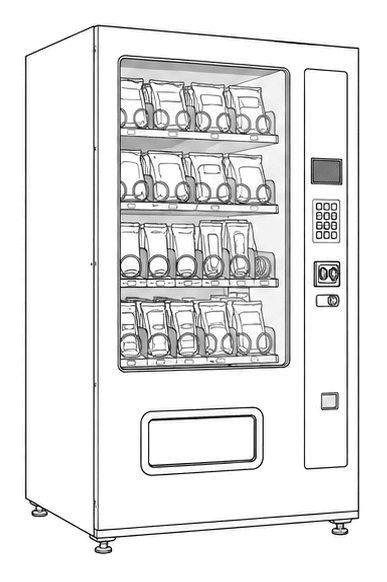
No Power Diagnostic Flow
Rowe 648 Showcase Merchandiser
No Power Diagnostic Flow
Systematic check for why the Rowe 648 Showcase shows no signs of electrical power. Begins with safe external checks and escalates only with evidence.
Qualified technician handoff: stop before live electrical testing, sealed-system refrigeration work, compressor service, or protected-compartment access unless a qualified technician is handling the work.
- Fuse blows immediately after replacement: Stop all work. Do not install a third fuse. Escalate to technician-advanced for short circuit location.
- Burning smell, arcing, or scorching detected at any point: Unplug machine immediately. Do not continue. Escalate to licensed electrician or manufacturer support.
Checklist
Guided Diagnostic Steps
Work from low-risk checks toward technician-level inspection only when evidence supports it.
You can read or print the route now. The first checkbox click opens the service contact gate.
- 1
Verify wall outlet has power
operator-intermediateunskilledPlug a known-good lamp or outlet tester into the same outlet the machine uses. Confirm the outlet is live.
Stop conditions- Outlet shows damage, scorch marks, or sparking - stop and contact licensed electrician.
Expected: Outlet tester shows correct wiring pattern or lamp illuminates.
Evidence to note: note
- 2
Outlet issue identified
operator-intermediateunskilledThe wall outlet does not have power or shows incorrect wiring. Do not plug the machine in elsewhere until the outlet is verified by a qualified electrician.
Stop conditions- Do not proceed until outlet is confirmed safe and live.
Expected: User stops and resolves outlet issue before continuing.
Evidence to note: note
- 3
Inspect power cord visually
operator-intermediateunskilledExamine the full length of the power cord from the machine to the plug. Look for cuts, kinks, exposed conductors, melted insulation, or signs of damage.
Stop conditions- Cord is damaged - do not apply power until cord is replaced.
Expected: Power cord is intact with no visible damage.
Evidence to note: photo
- 4
Damaged power cord
operator-intermediatehighA damaged power cord must be replaced before the machine can be safely powered. Do not attempt to tape or repair the cord. Replace with a cord rated for this machine's requirements.
Stop conditions- Do not power on with damaged cord.
Expected: Power cord is replaced with a compatible, undamaged cord.
Evidence to note: note
- 5
Check internal fuse or circuit breaker
operator-intermediatehighWith the machine unplugged, access the power entry area inside the cabinet. Locate the main fuse or circuit breaker. Inspect for a blown fuse or tripped breaker. If a fuse is blown, note its rating before replacing. Do not substitute a different rating.
Stop conditions- Fuse appears blackened or breaker housing is melted - do not replace until cause is identified.
Expected: Fuse is intact or breaker is in the ON position.
Evidence to note: photo
- 6
Blown fuse or tripped breaker found
operator-intermediatehighReplace the fuse with one of exactly the same type and rating. If a breaker tripped, reset it once. Power on and observe. If the fuse blows or breaker trips again immediately, stop - there is a short circuit that must be located before replacing again.
Stop conditions- Fuse blows a second time - stop and hand off to technician-advanced.
Expected: Machine powers on after one fuse replacement or breaker reset.
Evidence to note: note
- 7
Short circuit confirmed - repeated fuse failure
technician-advancedhighThe machine has a short circuit causing repeated fuse failure. Do not attempt another fuse replacement. This requires systematic isolation of the short by a qualified technician.
Stop conditions- Do not power on. Leave unplugged.
Expected: Machine is left unplugged and tagged out for technician.
Evidence to note: note
- 8
Check for voltage at controller board
technician-advancedlive-voltageWith the machine plugged in and power on, carefully measure voltage at the controller board's power input terminals. Use appropriate caution - this is a live voltage check. If uncomfortable, hand off to a qualified technician.
Qualified technician handoff: stop before live electrical testing, sealed-system refrigeration work, compressor service, or protected-compartment access unless a qualified technician is handling the work.
Stop conditions- Any sign of arcing, burning smell, or heat - unplug immediately.
Expected: Voltage present at controller input within expected range for this machine.
Evidence to note: meter-reading
- 9
Controller has power but machine appears dead
operator-intermediatehighPower reaches the controller but the machine shows no signs of life. The controller board may have an internal failure. Before replacing, verify all harness connections to the controller are seated. Check for any status LEDs on the controller that might indicate its state.
Expected: Controller status LED or other indication of board activity.
Evidence to note: note
- 10
Controller shows LED activity but machine non-functional
operator-intermediatehighThe controller appears alive but the display and vend functions are dead. This points to a harness, display, or peripheral issue. Check the display harness connection and the main harness routing for damage.
Expected: Identify loose or damaged harness connection.
Evidence to note: photo
- 11
Controller board appears failed
technician-advancedhighPower reaches the controller input but the board shows no LED or any sign of activity. Before replacing the controller board, review the replacement guard checklist. If all guards pass, the controller board is the likely cause.
Stop conditions- Do not replace controller until all guards in guard_controller_board are satisfied.
Expected: Decision on controller board replacement after guard review.
Evidence to note: note
- 12
No voltage at controller board
technician-advancedlive-voltagePower enters the machine but does not reach the controller. The wiring between the power entry and the controller has an open circuit. Trace the power path and check for an intermediate connector, terminal block, or internal breaker that may be open.
Qualified technician handoff: stop before live electrical testing, sealed-system refrigeration work, compressor service, or protected-compartment access unless a qualified technician is handling the work.
Stop conditions- Any sign of burned wiring - stop and do not apply power.
Expected: Locate the open point in the power path.
Evidence to note: meter-reading
Tools for this route
Parts status
Exact public parts list not verified yet. Use this route to identify the system before ordering.
Candidate areas for part verification
Other Possible Issues
Switch routes if this symptom is not the closest match.