
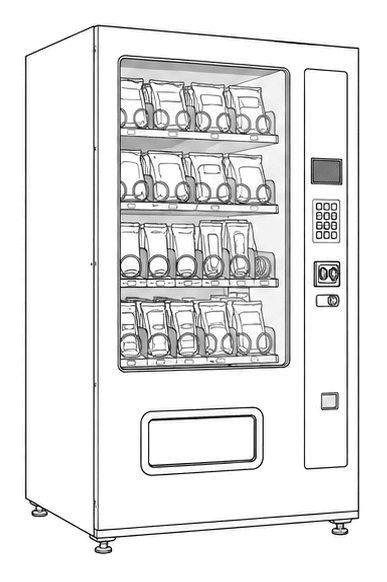
Machine Completely Unresponsive — Diagnostic Flow
VendnetUSA 4206415
Machine Completely Unresponsive — Diagnostic Flow
This guide assists in diagnosing why the entire machine appears dead, showing no signs of power or activity when switched on.
- Burning smell, visible arcing, heat damage, or water intrusion near electrical components: Disconnect power immediately. Do not continue diagnosis. Escalate to qualified technician.
- Facility outlet is dead or miswired: Do not modify facility wiring. Contact building electrician.
- If you suspect an issue with the main power input or internal wiring, contact a qualified technician immediately.
- If voltage verification is required, only a qualified technician should proceed with testing the low-voltage supply output.
Checklist
Guided Diagnostic Steps
Work from low-risk checks toward technician-level inspection only when evidence supports it.
You can read or print the route now. The first checkbox click opens the service contact gate.
- 1
Visually confirm the power source at the wall outlet is active and fu...
operator-intermediatecaution — line voltage may be presentVisually confirm the power source at the wall outlet is active and functioning correctly.
Stop conditions- If you suspect an issue with the main power input or internal wiring, contact a qualified technician immediately.
- If voltage verification is required, only a qualified technician should proceed with testing the low-voltage supply output.
- If the issue points to the main power entry or internal wiring, a qualified technician must perform the necessary electrical checks.
Expected: Initial condition is documented before deeper diagnosis.
Evidence to note: note
- 2
Inspect the entire power cord and plug for any visible signs of damag...
operator-intermediatecaution — line voltage may be presentInspect the entire power cord and plug for any visible signs of damage, such as cuts or severe kinks.
Stop conditions- If you suspect an issue with the main power input or internal wiring, contact a qualified technician immediately.
- If voltage verification is required, only a qualified technician should proceed with testing the low-voltage supply output.
- If the issue points to the main power entry or internal wiring, a qualified technician must perform the necessary electrical checks.
Expected: Initial condition is documented before deeper diagnosis.
Evidence to note: note
- 3
Verify the power outlet is live.
operator-intermediatecaution — line voltage may be presentVerify the power outlet is live.
Stop conditions- If you suspect an issue with the main power input or internal wiring, contact a qualified technician immediately.
- If voltage verification is required, only a qualified technician should proceed with testing the low-voltage supply output.
- If the issue points to the main power entry or internal wiring, a qualified technician must perform the necessary electrical checks.
Expected: Result is documented before continuing the route.
Evidence to note: note
- 4
Inspect the power cord and plug.
operator-intermediatecaution — line voltage may be presentInspect the power cord and plug.
Stop conditions- If you suspect an issue with the main power input or internal wiring, contact a qualified technician immediately.
- If voltage verification is required, only a qualified technician should proceed with testing the low-voltage supply output.
- If the issue points to the main power entry or internal wiring, a qualified technician must perform the necessary electrical checks.
Expected: Result is documented before continuing the route.
Evidence to note: note
- 5
Check the main fuse or circuit breaker.
operator-intermediatecaution — line voltage may be presentCheck the main fuse or circuit breaker.
Stop conditions- If you suspect an issue with the main power input or internal wiring, contact a qualified technician immediately.
- If voltage verification is required, only a qualified technician should proceed with testing the low-voltage supply output.
- If the issue points to the main power entry or internal wiring, a qualified technician must perform the necessary electrical checks.
Expected: Result is documented before continuing the route.
Evidence to note: note
- 6
Perform an internal visual inspection of the power path.
operator-intermediatecaution — line voltage may be presentPerform an internal visual inspection of the power path.
Stop conditions- If you suspect an issue with the main power input or internal wiring, contact a qualified technician immediately.
- If voltage verification is required, only a qualified technician should proceed with testing the low-voltage supply output.
- If the issue points to the main power entry or internal wiring, a qualified technician must perform the necessary electrical checks.
Expected: Result is documented before continuing the route.
Evidence to note: note
- 7
Verify the low-voltage supply output for a qualified technician.
operator-intermediatecaution — line voltage may be presentVerify the low-voltage supply output for a qualified technician.
Stop conditions- If you suspect an issue with the main power input or internal wiring, contact a qualified technician immediately.
- If voltage verification is required, only a qualified technician should proceed with testing the low-voltage supply output.
- If the issue points to the main power entry or internal wiring, a qualified technician must perform the necessary electrical checks.
Expected: Result is documented before continuing the route.
Evidence to note: note
- 8
Investigate the root cause of any blown fuses.
operator-intermediatecaution — line voltage may be presentInvestigate the root cause of any blown fuses.
Stop conditions- If you suspect an issue with the main power input or internal wiring, contact a qualified technician immediately.
- If voltage verification is required, only a qualified technician should proceed with testing the low-voltage supply output.
- If the issue points to the main power entry or internal wiring, a qualified technician must perform the necessary electrical checks.
Expected: Result is documented before continuing the route.
Evidence to note: note
- 9
Address any found damage before attempting to restore power.
operator-intermediatecaution — line voltage may be presentAddress any found damage before attempting to restore power.
Stop conditions- If you suspect an issue with the main power input or internal wiring, contact a qualified technician immediately.
- If voltage verification is required, only a qualified technician should proceed with testing the low-voltage supply output.
- If the issue points to the main power entry or internal wiring, a qualified technician must perform the necessary electrical checks.
Expected: Result is documented before continuing the route.
Evidence to note: note
- 10
Evaluate the controller board connections.
operator-intermediatecaution — line voltage may be presentEvaluate the controller board connections.
Stop conditions- If you suspect an issue with the main power input or internal wiring, contact a qualified technician immediately.
- If voltage verification is required, only a qualified technician should proceed with testing the low-voltage supply output.
- If the issue points to the main power entry or internal wiring, a qualified technician must perform the necessary electrical checks.
Expected: Result is documented before continuing the route.
Evidence to note: note
Tools for this route
Parts status
Exact public parts list not verified yet. Use this route to identify the system before ordering.
Candidate areas for part verification
Other Possible Issues
Switch routes if this symptom is not the closest match.