
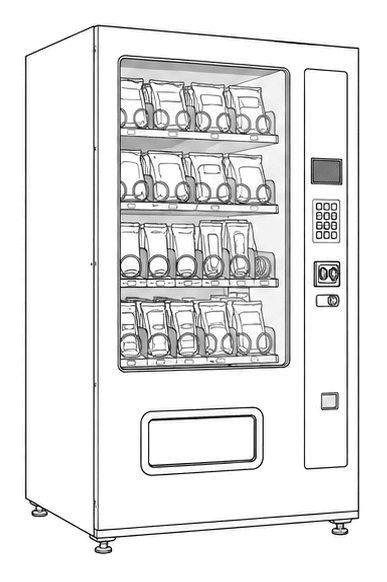
Products Not Cold — Refrigeration Diagnosis
Vendo Vendo V 12
Products Not Cold — Refrigeration Diagnosis
Non-invasive through moderately invasive diagnostic flow for identifying why the Vendo V-12 is not maintaining target product temperature, covering airflow, condenser condition, compressor operation, and sealed-system indicators.
Qualified technician handoff: stop before live electrical testing, sealed-system refrigeration work, compressor service, or protected-compartment access unless a qualified technician is handling the work.
- Oil residue found near compressor or fittings: Likely refrigerant leak — tag machine, do not attempt sealed-system repair, escalate to licensed technician
- Compressor running but extremely hot with knocking sound: Power down immediately — risk of compressor burnout; escalate
- Repeated evaporator ice-up after cleaning and door seal check: Escalate — possible undercharge or defrost system failure requiring sealed-system technician
Checklist
Guided Diagnostic Steps
Work from low-risk checks toward technician-level inspection only when evidence supports it.
You can read or print the route now. The first checkbox click opens the service contact gate.
- 1
Inspect condenser coil and airflow path
operator-intermediatelowRemove or open the lower rear panel. Visually inspect the condenser coil for dust and debris. Ensure no boxes, walls, or objects are blocking the machine's ventilation openings.
Qualified technician handoff: stop before live electrical testing, sealed-system refrigeration work, compressor service, or protected-compartment access unless a qualified technician is handling the work.
Stop conditions- condenser fan blades accessible — keep fingers clear
Expected: Condenser coil should be clean with visible fin spacing; airflow path clear
Evidence to note: photo
- 2
Clean condenser coil
operator-intermediatelowUsing a coil brush and vacuum, carefully clean dust from the condenser coil fins. Brush in the direction of the fins to avoid bending them. Vacuum loosened debris.
Qualified technician handoff: stop before live electrical testing, sealed-system refrigeration work, compressor service, or protected-compartment access unless a qualified technician is handling the work.
Stop conditions- fins severely corroded or damaged — do not force clean
Expected: Coil fins visibly clean with clear air passages
Evidence to note: photo
- 3
Check evaporator frost pattern
operator-intermediatelowObserve the evaporator coil through the access point or glass. A healthy system shows light, even frost. Heavy ice buildup indicates a defrost or airflow issue. A single cold spot with the rest warm may indicate a sealed-system problem.
Qualified technician handoff: stop before live electrical testing, sealed-system refrigeration work, compressor service, or protected-compartment access unless a qualified technician is handling the work.
Stop conditions- do not chip or pick at ice — allow natural defrost
Expected: Light, even frost across the evaporator surface
Evidence to note: note
- 4
Verify compressor electrical input
technician-advancedlive-voltageSafely check for voltage at the compressor electrical input area. This confirms the compressor is receiving run voltage from the controller.
Qualified technician handoff: stop before live electrical testing, sealed-system refrigeration work, compressor service, or protected-compartment access unless a qualified technician is handling the work.
Stop conditions- not qualified for live-voltage measurement — stop and hand off
Expected: Voltage present at compressor input during cooling call
Evidence to note: meter-reading
Tools for this route
Location Help
Where to find this
Use this as orientation before touching the machine. It is location help, not a repair instruction.
Start at the affected product shelf or selection row; compare the tray, coil, and product path with a nearby working selection.
- Maintains product at target serving temperature through forced-air circulation over evaporator coil
- compressor
- condenser coil and fan
- evaporator coil and fan
Do not open sealed-system or compressor areas unless a qualified refrigeration technician is handling the work.
cabinet drink spiral coil
 delivery bin sensor
 refrigeration bay
Parts status
Exact public parts list not verified yet. Use this route to identify the system before ordering.
Candidate areas for part verification
Other Possible Issues
Switch routes if this symptom is not the closest match.