
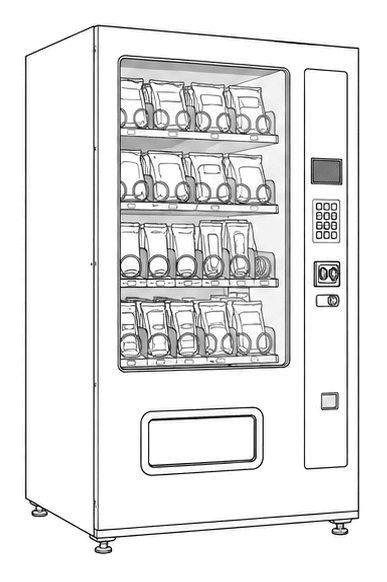
Completely Dead Machine Diagnostic
Vendo Vendo V8
Completely Dead Machine Diagnostic
Systematic check from wall outlet through power input to low-voltage supply, identifying where power is lost.
Qualified technician handoff: stop before live electrical testing, sealed-system refrigeration work, compressor service, or protected-compartment access unless a qualified technician is handling the work.
- Fuse blows more than once: Stop all work. Tag out. Escalate to senior technician. Do not apply power again.
- Burning smell detected at any point: Unplug immediately. Do not re-energize. Tag out. Escalate.
Checklist
Guided Diagnostic Steps
Work from low-risk checks toward technician-level inspection only when evidence supports it.
You can read or print the route now. The first checkbox click opens the service contact gate.
- 1
Verify wall outlet
operator-intermediateunskilled-safePlug a known-good lamp or outlet tester into the wall outlet the machine uses. Confirm the outlet has power.
Expected: Lamp illuminates or tester indicates correct wiring.
Evidence to note: note
- 2
Inspect power cord visually
operator-intermediateunskilled-safe — must be unpluggedWith machine unplugged, examine the full length of the power cord for cuts, kinks, melting, or exposed conductors.
Stop conditions- Cord is damaged — do not plug in until replaced
Expected: Cord is intact with no visible damage.
Evidence to note: photo
- 3
Check input fuse or breaker
operator-intermediatetechnician-basic — must be unpluggedWith machine unplugged, locate the main fuse or circuit breaker on the machine. Visually inspect the fuse element or breaker position. If a glass fuse, check for darkened or broken element.
Expected: Fuse element is intact or breaker is in ON position.
Evidence to note: photo
- 4
Check low-voltage power supply output
technician-advancedtechnician-advanced — live voltage present at input side of power supplyThis step requires live measurement. If not qualified, hand off now. With machine plugged in and power on, carefully measure the low-voltage DC output from the power supply at its output connector. Record the voltage.
Qualified technician handoff: stop before live electrical testing, sealed-system refrigeration work, compressor service, or protected-compartment access unless a qualified technician is handling the work.
Stop conditions- Any burning smell during measurement — unplug immediately
- Input voltage to power supply is absent — trace back to input fuse area
Evidence to note: meter-reading
- 5
Observe controller for signs of life
operator-intermediatehighWith power confirmed to the controller, look for any LED indicators, display activity, or relay click sounds.
Expected: At least one LED or display segment active.
Evidence to note: note
- 6
Outlet has no power
operator-intermediateunskilled-safeThe wall outlet is not supplying power. Check circuit breaker panel for the facility. Try a different outlet if available and safe.
Expected: Machine operates from known-good outlet.
Evidence to note: note
- 7
Power cord is damaged
operator-intermediatetechnician-basic — must remain unplugged during replacementDo not power the machine with a damaged cord. The cord must be replaced with a cord of equivalent or greater rating. Verify correct replacement specifications.
Stop conditions- Do not apply power until replacement is verified safe
Expected: New cord installed correctly and safely.
Evidence to note: note
- 8
Input fuse is blown
operator-intermediatehighReplace fuse with the same type and rating only. Using a higher-rated fuse is a fire hazard and is prohibited. If replacement fuse also blows immediately, a short circuit exists downstream — stop and hand off.
Stop conditions- Second fuse blows — short circuit, do not repeat
Expected: Replacement fuse holds and machine powers on.
Evidence to note: note
- 9
Low-voltage power supply has no output
technician-advancedtechnician-advanced — live measurementPower supply output is absent or out of specification. Before replacing, verify input voltage to the power supply is correct. Check for loose connectors at the supply.
Expected: Determines if power supply is the root cause.
Evidence to note: meter-reading
- 10
Controller shows no signs of life
technician-advancedhighPower supply output is confirmed good but controller is unresponsive. Do not replace controller until all harness connections, ground connections, and display connections are verified.
Expected: Confirmation that all inputs to the controller are present.
Evidence to note: note
- 11
Controller alive — narrow to affected peripheral
operator-intermediatehighThe main controller boots but something downstream is not functioning. Document which subsystem is affected and route to the appropriate symptom flow.
Expected: Identified specific subsystem for further diagnosis.
Evidence to note: note
- 12
Hand off to qualified technician
operator-intermediateunskilled-safeThis issue requires advanced diagnosis, manufacturer support, or licensed repair. Tag machine out of service and document all findings so far.
Expected: Machine is safe and tagged; findings communicated.
Evidence to note: note
Tools for this route
Parts status
Exact public parts list not verified yet. Use this route to identify the system before ordering.
Candidate areas for part verification
Other Possible Issues
Switch routes if this symptom is not the closest match.